

Golf Course Road, Golf Course Extension Road, Dwarka Expressway, New Gurgaon, SPR and Sohna Road are not one market. They are different markets with different prices, different neighbourhoods and different risks.
The right sector for you depends on six things: your budget, whether you will live there or invest, the type of property, your daily commute, your lifestyle and how long you plan to hold.
There is no single best sector for every buyer. The right choice depends on your budget, your purpose and how much you value an already-developed neighbourhood.
| Corridor | Best Suited For | Market Character | Key Advantage | Main Consideration |
| Golf Course Road | Luxury buyers, senior professionals | Established, premium | Mature neighbourhood, Rapid Metro access in parts, office proximity | Highest entry prices |
| Golf Course Extension Road | Premium end users, mid-term investors | Premium, still filling in | Wide choice of premium projects | Heavy new supply, traffic at peak hours |
| Dwarka Expressway | Delhi- and airport-oriented buyersFamilies, budget-conscious buyers | Developing, fast-changing | Direct expressway link towards Delhi | Metro and several connections still pending |
| New Gurgaon (Sectors 82–95) | Families, budget-conscious buyers | Developing, end-user driven | Lower price band, many family-oriented societies | Daily-life ecosystem still maturing |
| SPR | Buyers who want a central-south location | Developing to established in parts | Links GCER, Sohna Road, NH-48 | Key elevated connections not yet built |
| Sohna Road | Mid-segment buyers | Mixed, partly established | Established residential belt, lower price band | Congestion, uneven quality across projects |
| Established Gurgaon (HUDA/HSVP sectors, older DLF phases) | Families who want maturity | Established | Schools, hospitals, markets already in place | Older stock, fewer new launches |
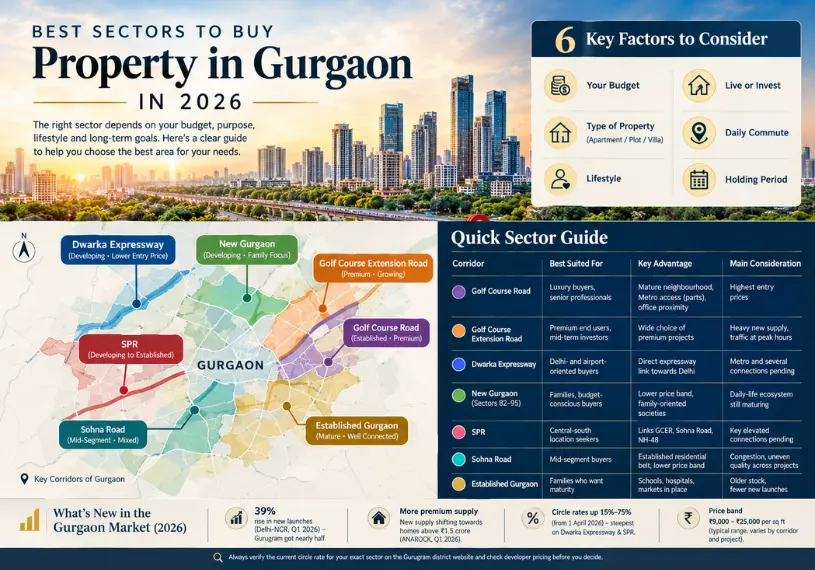
Fact: Delhi-NCR new launches rose 39% quarter-on-quarter in the quarter reported by Cushman & Wakefield in January 2026. Gurugram accounted for nearly half of them.
Fact: ANAROCK's Q1 2026 report shows new supply shifting towards homes priced above ₹1.5 crore.
Buyer interpretation: There are more choices than before, but more of them are premium. Mid-income buyers have to look more carefully at which corridors still have options in their budget.
Fact: Gurugram circle rates went up 15% to 75% from 1 April 2026, with the steepest increases on the Dwarka Expressway and SPR belts.
Buyer interpretation: Registration and stamp duty costs are higher, especially in those corridors. Add this to your total acquisition cost before you shortlist.
What to verify: the current circle rate for your exact sector on the Gurugram district website.
A note on prices: Published price bands in Gurgaon run from roughly ₹9,000 to over ₹25,000 per sq ft depending on the corridor and project. Recent premium launches on Golf Course Extension Road and Dwarka Expressway have been priced across a very wide band, from about ₹13,000 to ₹40,000 per sq ft. Actual price depends on project, developer, floor, unit size, construction stage and inventory. Check current developer pricing before you decide.
Market maturity: Established
Why buyers consider it. This is Gurgaon's most recognised premium address. Buyers choose it for the neighbourhood, the existing ecosystem and the proximity to offices.
Property market. Mostly luxury and ultra-luxury apartments, along with older premium low-rise stock around the DLF phases. Premium projects here are among the most expensive in the city.
Connectivity. Rapid Metro serves Sectors 53 to 56 and Cyber City, with an interchange to the Delhi Metro Yellow Line at Sikanderpur. Cyber City and other employment hubs are close. Road access to NH-48 is good, though peak-hour traffic is heavy.
Daily life. Private hospitals such as Artemis (Sector 51), Paras (Sector 43), Fortis Memorial (Sector 44) and Medanta (Sector 38) are in or near the central belt. Malls, clubs and restaurants are close at hand.
Who should consider it. Luxury buyers, senior professionals working in Cyber City or Udyog Vihar, and buyers who want an established area over a new one.
Who should think twice. Buyers on a mid-segment budget. Entry prices here are among the highest in Gurgaon.
Investment view. Supply is limited, and demand is driven by corporate employment and premium housing. But the high entry price means rental yields on residential property are modest, and resale depends heavily on project quality. Published estimates commonly put residential yields in low single digits.
Main risks. High entry price, peak-hour congestion, and a thin market for very high-priced units.
Bottom line. Best for buyers who value maturity and are comfortable with a premium price.
Market maturity: Developing, with some established pockets
Why buyers consider it. It offers newer premium projects at a lower entry cost than Golf Course Road, and good road links.
Property market. Largely premium and luxury apartments, with many new launches. The corridor spans roughly Sectors 56 to 67, with launches active in places such as Sectors 57, 63A, 65 and 66.
Connectivity. The road connects Golf Course Road, Sohna Road and SPR. Metro access is limited. A metro extension towards Vatika Chowk and Panchgaon has been discussed but is not sanctioned, based on the latest published reports.
Daily life. Malls, schools and retail have grown steadily. Social infrastructure is better in sectors closer to Golf Course Road and thinner further out.
Who should consider it. Premium end users and mid-term investors who want a newer home and are comfortable paying a premium.
Who should think twice. Buyers who rely on public transport, or who want a fully settled neighbourhood immediately.
Investment view. Demand comes from employment hubs nearby and premium housing demand. But several large launches are competing for the same buyers. Compare supply in your sector before buying.
Main risks. Heavy new supply, traffic at peak hours, and varying project density.
Bottom line. A strong choice for premium end users, provided you check the project and sector supply closely.
Market maturity: Developing
Why buyers consider it. It offers a direct expressway route towards Delhi and the airport side, and a large number of new projects.
Property market. Mostly new apartments, from mid-premium to luxury. Active sectors include the 99 to 115 belt (Sectors 102, 103, 104, 106, 109 and 113 among them).
Connectivity. The Dwarka Expressway is operational. It runs from Shiv Murti near Mahipalpur, next to IGI Airport, to the Kherki Daula toll plaza on NH-48.
Metro is not yet operational. A 28.5 km Millennium City Centre to Cyber City metro corridor, with a spur to Sector 101 on the expressway, was approved by the Union Cabinet in 2023. It is under development, not running.
Global City, a 1,000-acre township along the expressway, was announced to get grade-separated links to the expressway, NH-48 and Pataudi Road in July 2026. These links are planned, not built.
Daily life. This is the area where daily-life infrastructure is least settled. Schools, hospitals and retail are growing but still catching up with the number of homes being built.
Who should consider it. Buyers who travel often to Delhi or the airport side, and buyers who accept a longer settling period.
Who should think twice. Families who need schools, healthcare and markets close by from day one.
Investment view. Demand is driven by connectivity and new supply. The risk is dependency: part of the case rests on infrastructure that is planned but not built, so timelines matter. Circle rates here rose sharply in 2026, which also raises your registration cost.
Main risks. Construction activity, infrastructure still under development, large future supply, and uneven social infrastructure.
Bottom line. Good for Delhi- and airport-oriented buyers who can live with an area still in progress.
Market maturity: Developing, end-user driven
Why buyers consider it. Lower price band than the premium corridors, and many family-oriented societies.
Property market. Apartments and builder floors, mostly mid-segment to mid-premium. Commonly quoted price bands are around ₹9,000 to ₹14,000 per sq ft, with sector and society quality making the difference. Some new launches in Sectors 82A, 88A and 89 start around the ₹1.7 crore mark for 3 BHK floors. Treat these as indicative.
Connectivity. Access to NH-48 and the Dwarka Expressway, and proximity to IMT Manesar for people who work there. Some sectors, such as 83 to 86, sit directly on the Dwarka Expressway corridor.
Daily life. Schools, clinics, retail and daily-needs shops have grown, though quality and distance vary a lot from sector to sector. Check the exact society and its surroundings.
Who should consider it. Families and first-time Gurgaon buyers who want more space for their budget.
Who should think twice. Buyers who want a short commute to Cyber City or Golf Course Road.
Investment view. The market is largely end-user driven, which tends to mean steadier occupancy but modest rental yields. Rental demand is helped by Manesar and Gurgaon employment, but depends on the society.
Main risks. Longer commutes to central Gurgaon, uneven social infrastructure, and variation in project quality.
Bottom line. Practical for budget-conscious families, if the commute works for you.
Market maturity: Developing, with established pockets
Why buyers consider it. SPR links Golf Course Extension Road, Sohna Road and NH-48. It also hosts a growing commercial belt, which supports demand for nearby housing.
Property market. A mix of premium apartments, floors and commercial projects across a belt of sectors from about 58 to 76. Residential prices here have risen strongly over recent years, and circle rates in Sectors 63 to 67 rose by about 45% in 2026.
Connectivity. SPR is about 16 km long. The Vatika Chowk underpass has improved the key junction. Elevated stretches (Ghata to Vatika Chowk, and Vatika Chowk to NH-48) are proposed. The latest published reports say the NH-48 to Vatika Chowk stretch needs fresh procurement after a tender was cancelled in June 2026. A metro line from Sector 56 along SPR towards Manesar is not sanctioned.
Daily life. Retail and offices are growing along the corridor. Social infrastructure is stronger near the Golf Course Extension Road end.
Who should consider it. Buyers who work along SPR, GCER or Sohna Road, and buyers who want a central-south location with good road links.
Who should think twice. Buyers relying on planned elevated roads or metro to make their commute work.
Investment view. Employment and commercial development support demand. But a large share of the connectivity story is planned, not built, so check what is actually operational.
Main risks. Infrastructure dependency, traffic at junctions, and rapid price rise that may already be reflected in current rates.
Bottom line. A sensible middle option, as long as you separate what exists today from what is promised.
Market maturity: Mixed
Why buyers consider it. Lower entry pricing than Golf Course Road or GCER, and an established residential belt.
Property market. Mid-segment to mid-premium apartments and floors. Prices are generally below the premium corridors, though they vary by project. Check current listings.
Connectivity. The Sohna Elevated Corridor is operational and has improved the road. The corridor links to NH-48, SPR and Golf Course Extension Road.
Daily life. Schools, hospitals and retail are present in the older parts of the corridor.
Who should consider it. Mid-segment end users who want an established area at a lower budget.
Who should think twice. Buyers sensitive to congestion, and buyers who want uniformly high-quality projects. Quality varies a lot on this road.
Investment view. Demand comes from established residential areas and offices nearby. The opportunity is in picking strong individual projects, because the corridor is uneven.
Main risks. Congestion, uneven project quality and density.
Bottom line. A budget-friendly choice for careful buyers, who should shortlist projects, not just the road.
Market maturity: Established
Why buyers consider it. These areas already have schools, hospitals, markets and a settled population. Sectors such as 14, 15, 17, 29, 31, 45 and 46, and the older DLF phases, Sushant Lok, South City and Palam Vihar, belong to this group.
Property market. Mostly older apartments, builder floors and independent houses. Fewer new launches.
Connectivity. Close to Old Gurgaon's markets, offices and the Yellow Line interchange side of the city.
Who should consider it. Families who want a ready-made neighbourhood.
Who should think twice. Buyers who want new construction and modern amenities.
Investment view. Established demand and a mature resale market. Circle rates rose more modestly here (about 15% in places such as Sector 29), compared with the growth corridors.
Main risks. Ageing buildings, limited new inventory, and higher maintenance on older stock.
Bottom line. A safe choice for liveability, with older stock as the trade-off.
Families
Look at established Gurgaon first, then the older, more settled parts of Golf Course Extension Road, Sohna Road and New Gurgaon. The priority list is schools, hospitals, daily markets and commute. Dwarka Expressway can work for families who accept a few years of change.
Investors
Compare entry price, supply and tenant demand together. Corridors near employment hubs, such as Golf Course Road, Golf Course Extension Road and SPR, have clearer tenant demand. Developing corridors offer lower entry prices but more risk.
Luxury Buyers
Golf Course Road for an established address. Golf Course Extension Road and Dwarka Expressway for newer luxury launches. Check project reputation, density and total charges, because very high price points can take longer to resell.
Rental Buyers
Tenants follow jobs. Look near Cyber City, Udyog Vihar, SPR's commercial belt and Manesar. Compact apartments in well-run societies usually rent more easily than very large or very premium units.
Buyers Near Delhi and the Airport
The Dwarka Expressway is the direct route towards Delhi's airport side. NH-48 serves the older Delhi-Gurgaon link, and the Yellow Line serves Old Gurgaon and Golf Course Road. Traffic and route decide actual travel time, so test the commute at your own working hours.
Long-Term Buyers
Established markets give predictable daily life. Developing markets give newer homes and a longer wait. Decide how much waiting you are comfortable with.
| Established | Developing | |
| Advantages | Existing residents, mature schools and hospitals, predictable daily life | Newer projects, newer infrastructure, wider choice |
| Limitations | Higher entry prices in premium areas, less new inventory | Construction activity, thinner social infrastructure, plans that can take time |
The right sector depends on the buyer.


© 2026 Grand Edge Infra. All Rights Reserved.


