


Start with your purpose, then fix a total budget that includes taxes and fees. Next, shortlist locations by your real daily commute, and pick a property type that suits your life. Finally, verify the developer, the project's RERA registration and the documents, and visit the property before you pay anything.
Gurgaon is not one market. Two projects a few kilometres apart can differ in price, roads, supply and legal risk. So the method matters more than the area name.
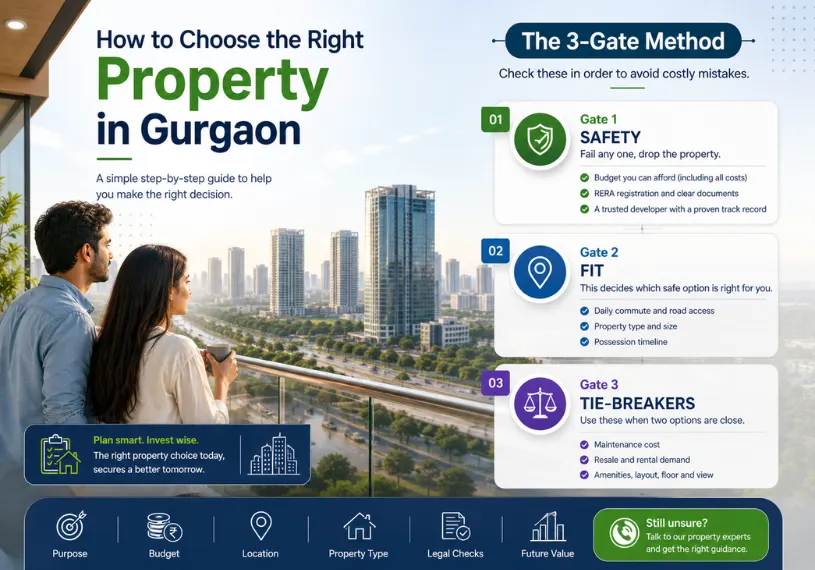
Most buyers check everything at once and get confused. A simpler way is to treat factors in three groups.
A cheap flat that fails Gate 1 is not a bargain. A beautiful flat that fails Gate 2 will annoy you every morning. Work through the gates in order.
| Purpose | What matters most | What to be careful about |
| First home to live in | Commute, schools, monthly affordability | Stretching the budget too far |
| Upgrade to a bigger home | Space, layout, society quality, resale of your old home | Paying two EMIs at the same time |
| Investment for rent | Tenant demand nearby, maintenance cost, vacancy | Assuming rent will cover the EMI |
| Long-term holding | Legal clarity, developer record, area supply | Infrastructure delays |
| Second home or family home | Convenience, security, low upkeep | Paying for amenities you rarely use |
Fact vs analysis: No source can promise rent or price rise for a given flat. Rental and resale outcomes depend on the specific project and timing, so treat them as things to evaluate, not things you are owed.
How much budget do you need to buy a property in Gurgaon? Enough to cover the full acquisition cost, not just the advertised price. Many buyers plan around the base price and then get surprised by the rest.
Here are the usual cost layers:
Illustrative example only (not a quote): Suppose an under-construction apartment has a base price of ₹1 crore and is bought by a man. GST at 5% would be about ₹5 lakh, and stamp duty at 7% would be about ₹7 lakh. That is ₹12 lakh before registration, parking, maintenance deposits, interiors and loan costs. The headline price and the real cost can be far apart.
Monthly affordability. Plan your EMI first, then your down payment. A common planning habit is to keep total EMIs within about 40% of your take-home income. That is a rule of thumb, not a law. Also keep an emergency fund separate from your down payment.
TDS note: When the sale price is ₹50 lakh or more, the buyer generally has to deduct tax at source and deposit it. Check the current rule with your CA, because tax laws are being updated.
What should you do? Build a sheet with every line above. Ask the seller to confirm each charge in writing.
Which location is best? The best location is the one that works for your life. Do not start with the area name. Start with a test.
Public transport and future plans: check the status. Many Gurgaon brochures show future metro lines and roads. Ask whether each one is operational, under construction, approved or only proposed.
Why this matters to your choice: If a project's appeal depends on a metro line that does not exist yet, you are buying a promise. That can still be reasonable, but it should not decide your purchase alone.
What should you do? Shortlist two or three locations. Test each at peak hour. Drop any that fail your commute test.
Should you buy an apartment or a builder floor in Gurgaon? Neither is better for everyone. Choose based on how you want to live and what you are willing to maintain.
| Apartment (in a society) | Builder floor / independent floor | Plot | Commercial unit | |
| Suits | Buyers who want amenities and security | Buyers who want privacy and fewer neighbours | Buyers who want to build their own home | Business owners or rental-focused buyers |
| Often an advantage | Shared security, lifts, clubhouse | More privacy, often a simpler building | Design freedom | Business or lease income potential |
| Often a limit | Monthly maintenance, shared rules | Fewer facilities, parking and lift may vary | Construction cost, time and approvals | Vacancy risk, different loan and tax rules |
| Maintenance | Usually through an association or manager | Often handled by residents themselves | You manage everything | Depends on the building |
| Key legal check | RERA, approvals, agreement | Title, share of land, building approvals | Licence of the colony, title, land records | Zoning, approvals, lease terms |
| Resale view | Depends on society and demand | Depends on area and building condition | Depends on location and approvals | Depends on tenant demand |
Builder floor tip: Ask about the land share, the structure's approved floors, and who maintains common areas.
Plot tip: Do not buy on a broker's word. Verify the colony or sector approval, the title and the land records with a lawyer.
What should you do? Decide how much privacy, amenities and maintenance responsibility you want. Then eliminate types that do not fit.
How do you check a developer? Look for proof, not reputation talk. "Famous" is not a verification method.
Be careful with claims such as "best developer". They cannot be verified. Look instead for a consistent record across several projects.
What should you do? Make a one-page note for each developer: past projects, delivery dates, resident feedback, any complaints.
Which BHK should you choose? The one that fits your family for the years you plan to stay, within an EMI you can handle.
Think about:
A larger unit is not automatically a better one.
What should you do? Ask for the carpet area and floor plan in writing. Mark where your bed, desk and wardrobes would go.
| Ready-to-move | Under-construction | |
| Possible advantages | You can see the actual home and surroundings. No wait for possession. Less construction-stage uncertainty. | Newer design and specifications. Payment is often linked to construction stages. Longer time to plan. |
| Possible limits | Price may be higher in some cases. Older specifications in some projects. | Delay risk. You cannot test the final result. GST applies. You may pay rent and EMI together. |
| Best check | Occupancy certificate and society condition | RERA registration, construction progress, escrow-related practice |
What should you do? If you need a home soon, favour ready or near-ready projects. If you choose under-construction, compare the site's actual progress with the RERA timeline, and plan your finances for a possible delay.
How important is RERA? Very. It is your first safety gate. RERA registration does not remove all risk, but it gives you a public record and legal remedies.
Why it matters: Under RERA, builders must keep a share of buyer payments in a dedicated project account, commonly described as 70%, to be used for that project's land and construction. If a developer fails to deliver on time, interest is payable to the buyer, and sources describe the rate as the SBI marginal cost lending rate plus 2%. Rules and remedies depend on the facts of each case, so ask a lawyer about your own situation.
Be careful with early booking money. Money paid as an "expression of interest" before a project is registered may not sit in the protected project account. Avoid paying booking or token amounts for an unregistered project.
Never treat a broker's listing as the final legal source. Verify on the official portal. Get a property lawyer to review the agreement and title for any serious purchase.
If you are an NRI: Generally, NRIs can buy residential and commercial property in India, but not agricultural land, farmhouses or plantation property. Payment routes, power of attorney and tax questions need professional advice from a CA or lawyer.
What should you check during a site visit? Go twice, once on a weekday morning and once on a weekend or evening. Bring a checklist.
Under-construction projects: Compare site progress with the RERA timeline and the developer's claims. Take dated photos on each visit.
What should you do? Print this list. Tick it off. Do not rely on a model flat or brochure.
Before you book, ask these questions and get answers in writing:
These are things to evaluate, not outcomes anyone can promise.
Words like "may support" and "could influence" are used on purpose. Ask local agents and current residents what comparable units recently rented or sold for. Compare actual deals, not asking prices.
The right property in Gurgaon is not necessarily the most expensive, the largest or the most popular one. It is the one that fits your purpose, budget, daily life, legal comfort and long-term plans.
Start with the safety gate, then test the fit, and use the tie-breakers last. If a property survives all three, you can buy with more confidence.

© 2026 Grand Edge Infra. All Rights Reserved.


