NRI Guide to Buying Property in Gurgaon: Rules & Process


Yes, an NRI can buy property in Gurgaon. You can buy apartments, houses, plots, offices and shops. You cannot buy agricultural land, a farmhouse or plantation property. This is the rule set by the Reserve Bank of India (RBI) under FEMA, India's foreign exchange law.
This guide covers the rest of the journey: how to pay, which papers you need, how to buy from abroad, which taxes apply, and how to bring money back after a sale. Rules and rates here are as of November 2026. They change, so confirm the latest with a lawyer and a Chartered Accountant before you pay.
An NRI is an Indian citizen who lives outside India. An OCI cardholder is a foreign citizen of Indian origin. For buying property, RBI treats both in the same way. Both can buy non-agricultural property. A foreign citizen with no Indian origin is not covered by this permission.
You will also hear the word "resident" in tax. FEMA status and income-tax status are decided by different tests. In the same year, you can be an NRI under one and a resident under the other. Ask your CA which applies to you before you pay tax.
You can buy apartments, builder floors, independent houses, residential plots, offices and shops. There is no limit on how many such properties you may own. Our residential listings show the size, status and RERA number of each project, so you can compare before you shortlist.
Plots are also open to you. Take Orris Woodview Residences in Sector 89, which offers plots from 200 to 400 sq. yd. Grand Edge Infra lists its RERA status as "coming soon". A careful NRI would wait for the registration number before paying anything.
Agricultural land, farmhouses and plantation property are different. You cannot buy them. You can inherit them, and you can keep land you owned before you became an NRI. You can sell such land only to a resident Indian. A relative who is a resident or an NRI can gift you non-agricultural property. A spouse can buy one property jointly with an NRI or OCI spouse. Be careful with anything sold as a "farmhouse" near Gurgaon. Ask a lawyer to check the land-use record first.
The money must come through banking channels. It can be sent from abroad, or it can sit in a non-resident account in India.
The three accounts are not the same. An NRE account holds your foreign earnings in rupees. An FCNR account is a foreign-currency deposit. An NRO account holds money earned in India, such as rent. The account you use affects how much you can send back after a sale, so choose with care. Never pay in cash. Never pay a developer's dues into a personal account.
Also remember that permission to buy and permission to send money abroad are two separate rules.

These terms mean different things. Booking reserves a unit. Allotment assigns you a specific unit. The Agreement for Sale sets the legal terms and the payment plan. The sale deed transfers ownership. Registration makes that transfer official at the Sub-Registrar's office.
Most buyers need a valid passport, a visa or residence permit, a PAN card, an OCI card if you hold one, overseas and Indian address proof, photographs, and details of your NRE or NRO account. For a loan, add income and employment proof and overseas bank statements. Joint buyers give the same identity papers. If someone signs for you, add the Power of Attorney. Developers, banks and registrars ask for different lists, so request the exact one in writing. Not every NRI needs every paper.
Often, yes. You can research projects, take video tours, complete KYC, pay by bank transfer and apply for a loan from abroad. Registration is the hard part. The Sub-Registrar's office in Gurgaon expects people to be present, so most NRIs send a trusted person with a Power of Attorney (POA).
A Special POA covers one job, such as buying or registering one flat. A General POA gives wide powers, which is riskier. A POA does not make the agent the owner. You stay the owner.
If you sign abroad, you usually get the POA notarised, then apostilled if your country is part of the Hague Convention, or attested by the Indian embassy. You send the original to India. Your agent then pays stamp duty on it, usually within about three months of its arrival, and registers it at the Sub-Registrar's office. Haryana's rules govern the details, so ask a local lawyer to draft it.
Keep the POA narrow. Name one person, one property, one purpose and an end date. Cancel it in writing when the work is done. Do not rely on a "sale agreement plus GPA plus will". The Supreme Court has said that route does not transfer ownership.
RERA registration is one check. It does not make a purchase risk-free. Before you pay, confirm the following.
Haryana RERA is the state regulator for real estate projects. Search the project on the Haryana RERA portal (haryanarera.gov.in). Check the registration number, how long it is valid, the promoter's name, approved plans and the project end date. The promoter's name should match the name on your agreement. Project registration and the Occupancy Certificate are different things. The first lets the developer sell. The second says the building is fit to live in.
If possession is late, you can complain to the Haryana RERA Gurugram authority under section 31 of the RERA Act. Refund claims use the authority's CRA form. It asks for the agreement details, the promised possession date, the delay, a payment sheet and your documents. Keep your allotment letter, agreement, receipts, bank proofs and all messages with the developer. If you live abroad, ask a Haryana lawyer how to file and appear. No outcome is guaranteed.
Indian banks and housing finance companies lend to NRIs. The loan is in rupees. You repay it from an NRE, NRO or FCNR account, or by remittance from abroad. Rent paid into an NRO account can also cover the EMI.
Rules differ by lender. Many ask for six months to two years of work abroad, around two to three years of total work experience, three to six months of payslips, six months of bank statements, a visa or work permit, and an employment contract. Age limits usually run to about 60. On a home under construction, banks usually release money in stages as the developer builds.
Before you choose, compare the interest rate, how much of the price the bank will fund, fees, prepayment terms and what happens if you lose your job. Read these on each lender's own page, because they change often.
In Gurugram, inside municipal limits, stamp duty is 7% for male buyers, 5% for women and 6% for joint male-and-female buyers. Outside municipal limits it is 5%, 3% and 4%. It is charged on the higher of the deal value or the circle rate. A registration fee comes on top. The Sub-Registrar can give you the exact amount.
GST applies only to homes under construction. It is 5% without input tax credit. For affordable housing it is 1%, which needs a price up to ₹45 lakh and a carpet area within the limit. Once the developer gets the Occupancy or Completion Certificate, GST no longer applies. A resale home carries no GST either.
Ask the developer for a written cost sheet. It should list the base price, parking, club membership, preferred location charges, maintenance deposit and every other charge. Add legal fees, loan fees and any brokerage.
A home under construction costs GST and carries delay risk, but the entry price may be lower. A ready home with an Occupancy Certificate has no GST and no delay risk, and it can start earning rent sooner. If you cannot watch a build from abroad, a ready home may feel safer.
On Grand Edge Infra, M3M Skywalk in Sector 74 is listed as ready to move, while M3M Crown in Sector 111 is listed under construction. Whichever you pick, match its RERA number on the portal yourself. For a ready home, ask to see the OC.
The Income-tax Act, 2025 took effect on 1 April 2026. It replaced the old section numbers and forms. Tax depends on your facts, so take a CA's advice for your case.
When you buy. If you buy from a resident Indian and the price is ₹50 lakh or more, the buyer deducts 1% TDS. If the seller is an NRI, the rule changes. The buyer deducts tax on the full price, not just the profit, under section 393(2). Do not mix up these two cases.
While you own. Rent is taxable in India. A tenant paying an NRI landlord must deduct TDS at 30% plus surcharge and cess. You may also need to file an Indian tax return. Property tax is separate.
When you sell. A gain on a property held for more than 24 months is long-term and is taxed at 12.5% without indexation. A shorter holding is taxed at slab rates. The buyer deducts TDS on the full price unless you obtain a lower-deduction certificate. Section 54 exemptions and tax treaties may reduce your tax in some cases. To send money abroad, your bank will ask for Form 145, your declaration, and Form 146, a CA's certificate. These replaced Forms 15CA and 15CB for payments from 1 April 2026.
Yes, you can rent out both residential and commercial property. Use a written rent agreement, verify the tenant, and decide who collects the rent. Rent usually goes into an NRO account. Plan for empty months, repairs and late payments. If you hire a property manager, put the duties, fees, repair limits and reporting in a written agreement. Do not count on a fixed rent until a tenant has signed.
Repatriation means sending eligible money from India to your country. It is not automatic, and you cannot freely send out every rupee. Your bank will ask for tax proof and Forms 145 and 146.
| If your money came from | What you can send abroad |
| Funds sent from abroad, or an NRE or FCNR account | Sale proceeds, for up to two residential properties |
| An NRO account, India-sourced money, or an inheritance | Up to USD 1 million a year, after tax |
| Agricultural land, farmhouse or plantation property | No automatic right. RBI permission is needed |
The right area depends on your purpose, budget and how long you will hold. Compare road access, jobs nearby, schools, hospitals, metro access, new supply, entry price and likely rent.
Here is what exists today. The Dwarka Expressway, about 29 km from Mahipalpur in Delhi to Kherki Daula in Gurugram, is open. It gives the western part of the city faster access to the airport and South Delhi. The Yellow Line and Rapid Metro already serve central Gurgaon, Golf Course Road and Cyber City. A metro along the Dwarka Expressway stretch is not running yet. The Gurugram metro loop is under construction, with the first phase targeted for 2028. The Sector 56 to Panchgaon line was still awaiting final approval in October 2026. The Dwarka Expressway extension and the elevated Southern Peripheral Road are plans, not finished roads. Buy for what exists today and treat planned projects as a bonus.
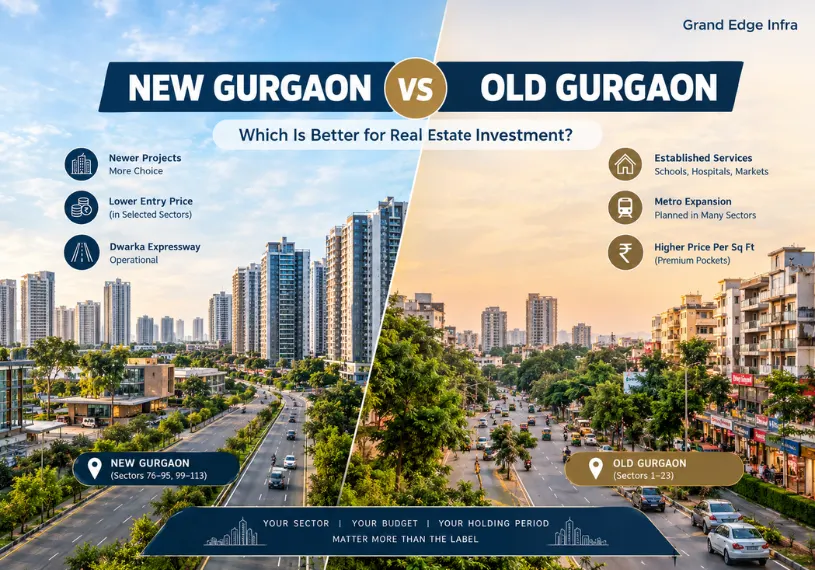
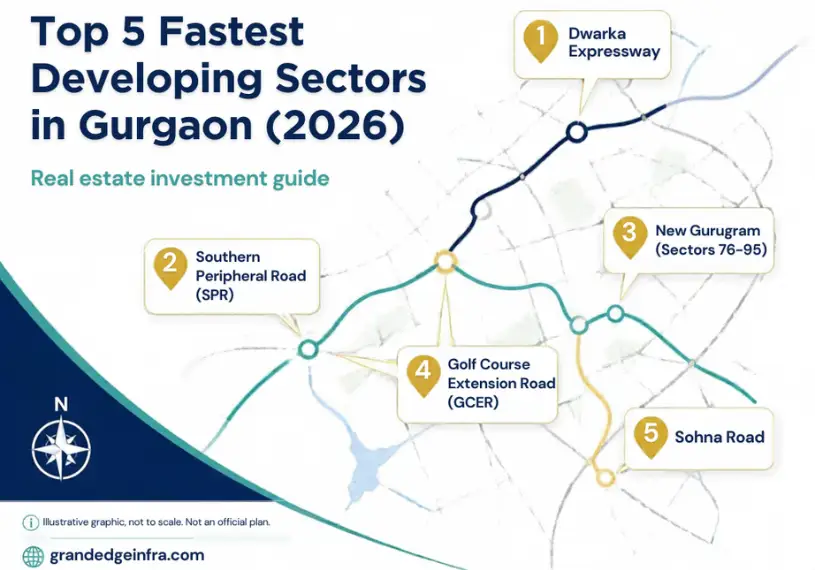
On the Dwarka Expressway side, Krisumi Waterfall Residences in Sector 36A offers 2, 3 and 4 LDK apartments from 1,448 sq. ft., according to Grand Edge Infra's listing. For a wider comparison of micro-markets, read our guides on New Gurgaon vs Old Gurgaon for investment and the fastest developing sectors in Gurgaon.
Residential property is easier to manage and usually has a wider pool of tenants. Commercial property depends heavily on location and on finding a business tenant, and an empty unit can stay empty longer. Neither is always safer or higher-yielding. Pick the one that matches your goal and your appetite for risk.
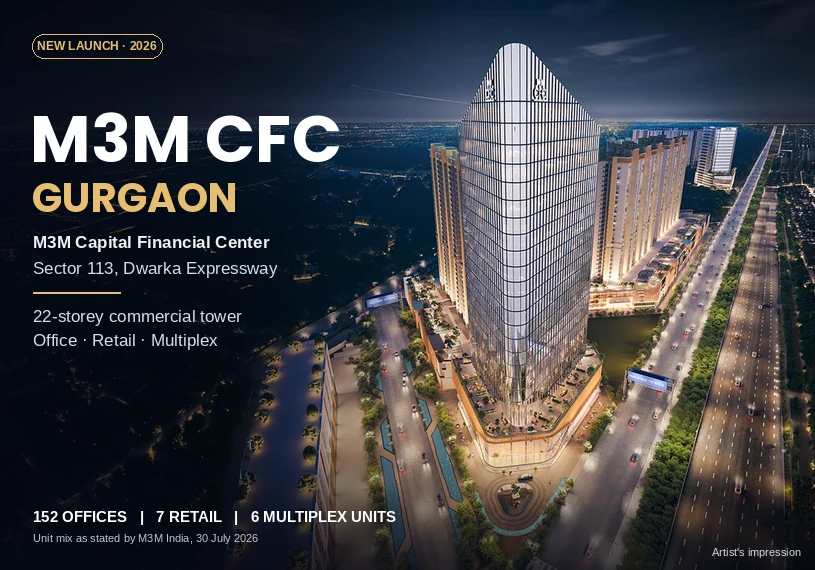
Our commercial listings include M3M Jewel in Sector 25, listed as ready to move, and M3M Paragon 57 in Sector 57, listed under construction. The same checks apply to both. Match the RERA number, read the lease or assured-return terms in writing, and ask who will manage the unit while you are abroad.
Buying in Gurgaon as an NRI is simple when you take it in order. Confirm you are eligible, choose an allowed property, pay through approved accounts, check the title and RERA record, and understand the tax before you sign. Then plan how you will rent, hold or sell.
© 2026 Grand Edge Infra. All Rights Reserved.